

Broadband FTIR Crystal
Potassium Bromide (KBr)
Very broad infrared transmission for FTIR beamsplitters, spectroscopy and CO₂ laser optics
Potassium Bromide (KBr) is a synthetic alkali-halide crystal with extremely broad optical transmission extending from the near-UV into the long-wave infrared. It is widely used for FTIR beamsplitters, spectroscopy windows and CO₂ laser optics. KBr is very soft and highly water soluble, so it requires dry storage, non-aqueous processing and careful environmental protection.
Is this material right for your application?
Use When:
Broad mid-IR transmission is required
FTIR spectroscopy is the primary application
Sample windows or pellets are used
Cost-effective IR materials are acceptable
The environment is dry and controlled
Avoid When:
Moist or humid environments are present
Mechanical handling is frequent
Outdoor or exposed systems are involved
Long-term durability without encapsulation is required
Consider Alternatives:
Potassium Chloride (KCl) – slightly improved durability
Sodium Chloride (NaCl) – lower cost for basic IR work
ZnSe – non-hygroscopic IR optics
Explore Related Optical Materials
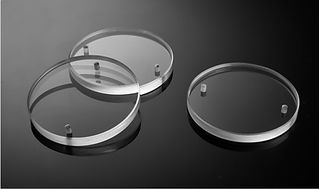
Sodium Chloride (NaCl)

Caesium Iodide (CsI)

Barium Fluoride (BaF₂)
Material specifications and frequently asked questions
FAQ
Q1. What wavelength range does KBr support?
A representative 2 mm KBr specimen transmits approximately from 0.21 to 33 µm.
Q2. Is KBr moisture-sensitive?
Yes. KBr is highly water soluble and should be stored and handled in dry conditions.
Q3. Where is KBr commonly used?
KBr is widely used for FTIR spectroscopy windows, cells and pellets.
Q4. What are common alternatives to KBr?
NaCl and CsI may be considered depending on spectral range and environmental constraints.
Extremely moisture sensitive
Soft and easily damaged
Best for controlled laboratory environments