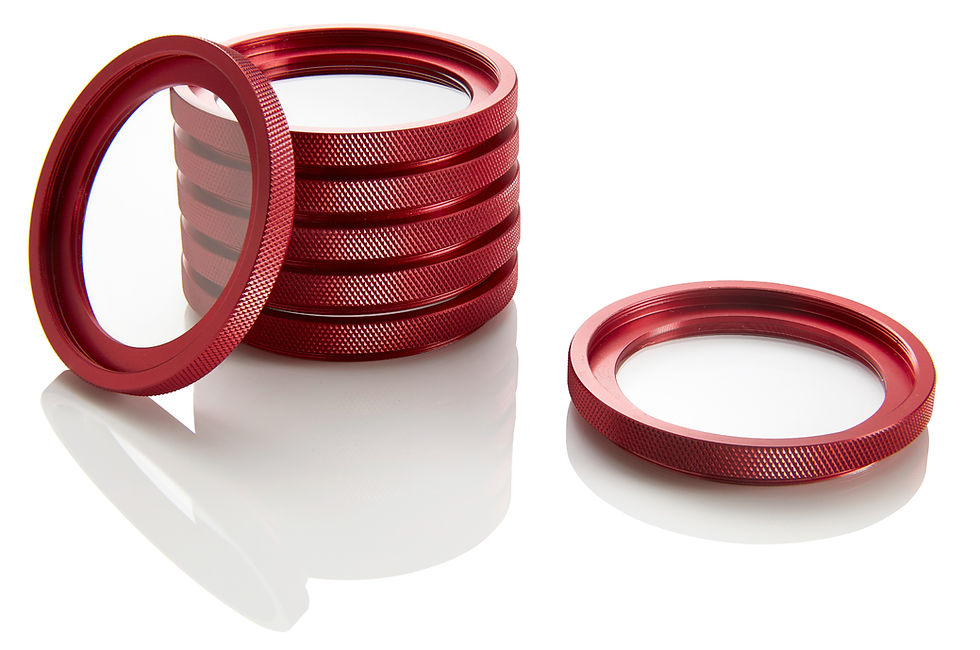
Optical Filters: Types, Applications, and How to Choose the Right One
Optical filters are a fundamental part of many scientific, industrial, and engineering systems. Their role is simple in principle — to control which wavelengths of light are transmitted or blocked — but in practice, selecting the right filter is critical to overall system performance.
Whether you are working with lasers, imaging systems, or spectroscopy equipment, understanding the different types of optical filters and how they behave in real applications is essential.
This guide outlines the main filter types, how they work, and what to consider when specifying them.
Understanding the Main Types of Optical Filters
Optical filters are designed to manipulate light in specific ways depending on the application. The most commonly used types include:
Absorptive filters
Dichroic (interference) filters
Bandpass filters
Longpass and shortpass filters
Neutral density filters
Polarising filters
Each serves a different purpose, and more importantly, each has its own limitations.
Absorptive Filters
Absorptive filters are typically made from coloured glass that absorbs unwanted wavelengths while transmitting others.
They are widely used in:
Photography
General lighting
Basic imaging applications
Their advantages include simplicity and low cost. However, they are not suitable for high-performance or high-power systems, as they can heat up and offer relatively broad spectral control.
Dichroic (Interference) Filters
Dichroic filters use thin-film coatings to reflect certain wavelengths while transmitting others. This allows for much sharper cut-offs and higher efficiency compared to absorptive filters.
They are commonly used in:
Laser systems
Scientific instrumentation
Fluorescence applications
One important consideration is angle sensitivity — the filter’s performance can shift depending on the angle of incoming light. This must be accounted for in system design.

Bandpass Filters
Bandpass filters transmit a defined wavelength range while blocking everything outside it.
Typical applications include:
Spectroscopy
Fluorescence microscopy
Laser line selection
When specifying bandpass filters, it is important to consider not just the centre wavelength, but also bandwidth, tolerance, and out-of-band rejection. Small specification gaps can lead to significant performance issues.
Longpass and Shortpass Filters
Longpass filters transmit wavelengths above a certain cut-off, while shortpass filters transmit wavelengths below it.
They are often used to:
Separate spectral regions
Reduce background noise
Improve signal clarity
It is important to note that cut-offs are not perfectly sharp — there is always a transition region that must be considered in design.
Neutral Density Filters
Neutral density (ND) filters reduce light intensity without significantly altering the spectral distribution.
They are used in:
Laser power control
Imaging systems
Sensor protection
ND filters are available in absorptive and reflective types, and selecting the correct version is important depending on power levels and system geometry.

Polarising Filters
Polarising filters transmit light with a specific orientation and block others.
They are commonly used for:
Reducing glare
Enhancing contrast
Analysing stress patterns
Their performance depends on wavelength, angle, and coating quality, making correct specification important for consistent results.
Types of Optics and System Considerations
Optical filters do not operate in isolation. They form part of a wider optical system, typically involving:
Refractive optics (lenses)
Reflective optics (mirrors)
Diffractive optics (microstructured elements)
The interaction between filters and the rest of the system — particularly angle of incidence and alignment — plays a significant role in overall performance.
Key Considerations When Selecting Optical Filters
Choosing the correct optical filter requires more than selecting a type. Key factors include:
Wavelength range – including centre wavelength and bandwidth
Angle of incidence – especially important for coated filters
Optical density – required attenuation level
Coatings – anti-reflective or protective layers
Environmental conditions – temperature, pressure, humidity
Size and mounting – ensuring compatibility with your system
Careful specification at this stage helps avoid performance issues later in the project.
Why Precision Matters
In many applications, optical filters are not just accessories — they are critical to system performance.
Incorrect or poorly specified filters can lead to:
Reduced signal quality
Measurement errors
System inefficiencies
Potential damage to sensitive components
Working with a specialist supplier ensures that filters are manufactured to specification and perform reliably within the intended application.
Final Thoughts
Selecting the right optical filter is about more than simply blocking or passing light. It is about ensuring your system performs consistently, accurately, and reliably.
By understanding the different types of filters and the factors that influence their performance, engineers and procurement teams can make informed decisions that support long-term project success.
If you require more detailed specifications or support with a particular application, working with a specialist optics supplier can provide access to technical data and guidance tailored to your requirements.